
It’s that time of year again: when the leaves turn colour, the air gets cooler, the nights longer, and the librarians delve into our special collections to find the creepy and weird. This year, two librarians picked a title that sparked their interest and came up with two unique books: one discussing the various types of ghosts, monsters, and fae creatures, and one musing on the supernatural. Each description is written in the librarian’s own voice.
Pen photographs of celebrated men and noted places, ghosts and their relations, tales, sketches, essays, etc., etc., by Daniel Clark, M.D., 18731
When I first came across this collection of stories, it did not seem to contain any supernatural elements, starting off with stories of Scottish men from the 19th century. Despite the title, there are no photographs or illustrations of any kind, instead relying on words to describe a scene or character. As I made my way through the book, the tales began to get a bit more fanciful.
In the chapter, “What Was It?”, I came across the story of “Black McPherson”, a captain with the British government charged with conscripting men into the army during the Napoleonic Wars in 1812. McPherson, known to be cruel, conscripted the only son of a widow who cursed the captain.

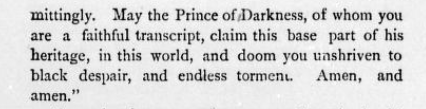
The widow’s curse, pg.188-9
Years later, after both the son and widow had died, McPherson is visited by a stranger flanked by two black dogs. A servant saw the interaction between McPherson and the stranger and became uneasy hearing the captain say, “I’ll be here this day twelve-months with them, for me2”. A year later McPherson organizes a hunting party and the servant made an excuse not to go. A fierce storm arrived and the hunting party never returned. Some people from the village go out to search for the hunting party and find the bodies of mutilated men and dogs including McPherson. His body is found without clothing except for one leg and whose skin is scorched beyond recognition. Clark has a certain amount of skepticism when relaying these tales, which isn’t surprising given that he is a doctor.
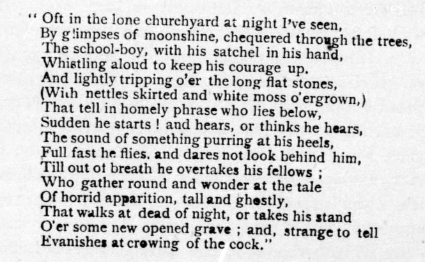
By far the strangest collection of tales in the book is titled “Ghosts and their Relations”. It begins by recounting various superstitions around the world. Some are familiar, like breaking a mirror brings bad luck, while others are strange and gruesome, such as the belief that eating the lungs of a greyhound will cure consumption. As I continued to read, expecting to come across stories of ghosts, Clark then launches into a catalogue of various supernatural beings found around the world. His descriptions come across as skeptical and even cross into ridicule, such as his descriptions of vampires: “Vampyres were graveyard frequenters of a sanguinary kind. They must have been a sort of ghostly weasels, and loved to suck human blood.3” Other supernatural beings he discusses include banshees, brownies, witches, and fairies. When ghosts do finally appear in the book, they are usually rationally explained by the author.
Despite providing a rational explanation for each supernatural tale, Daniel Clark still makes sure to refer to “his satanic majesty” in polite terms…just in case.
The Supernatural? by Lionel A. Weatherly, M.D., 1891
Upon hearing that this year’s topic for the Halloween blog post would be “weird/scary volumes in the Riddell Collection”, I went straight for the Philosophy/Psychology/Religion section, sure I’d find there an appropriately bizarre tome to share with you. With titles like Essays in Occultism, Spiritism, and Demonology (W.R. Harris, 1919) and Sidonia the Sorceress: The Supposed Destroyer of the Whole Reigning Ducal House of Pomerania (William Meinhold, translated by Lady Wilde. Mary Schweidler the Amber Witch, 1894) on the shelf nearby, I felt certain that The Supernatural? (Weatherly & Maskelyne, 1891) should contain some turn-of-the-20th-century horror and/or mysticism that would captivate readers of this blog.
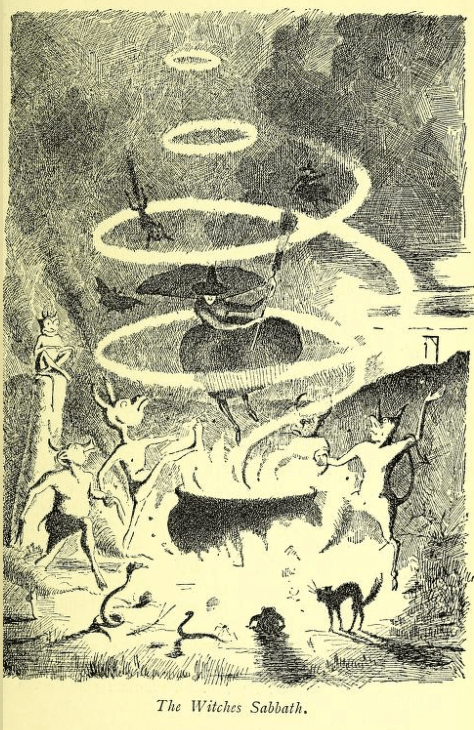
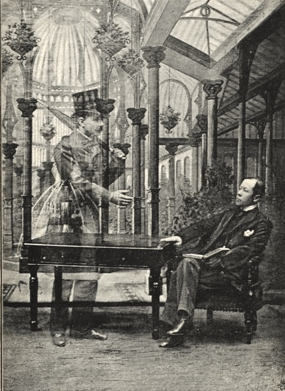
Image from ch.1, pg. 3
Upon closer inspection, however, I found that the question mark in the title reveals more than I realized about the book’s intent; specifically, that it aligns with the anti-spiritualist movement, which accompanied the rapid technological and scientific innovation occurring at the time of its publication. Chapters like “The Giant of the Brocken Mountain”, “Vampires”, and “Miss Bailey’s Ghost” are not accounts of fascinating unsolved mysteries like I hoped, but scientifically methodical explanations of such phenomena, and Weatherly & Maskelyne among the original Mythbusters.

Image from ch.4, pg. 46
Not only do the authors debunk stories of mirages, prophetic dreams, and the experiences of historical figures like Joan of Arc, “a chapter by famous illusionist and inventor J. N. Maskelyne… famously exposed the fraud of a number of spiritualists, and created illusions which are still performed today4”. I guess at least the authors’ mission to expose “the faulty and weak reasoning of the ignorant, uneducated, and superstitious5” resulted in the creation of some new magic, of a type.
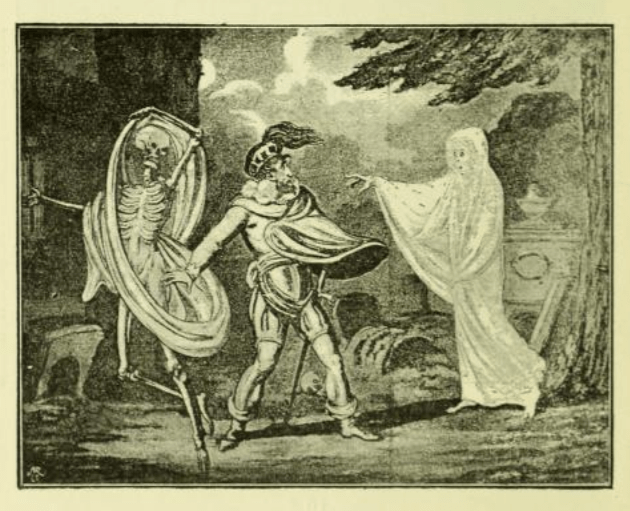
“No no, you’re mistaken, no errant skeletal apparitions over here.”
Image from ch.6, pg. 132
Still, I was disappointed by the book’s stubbornly practical stance. I couldn’t help but wonder: is the scariest feature of the book I chose the joyless rationalization of magical beliefs by Men of Science?
It is no surprise that both books examined ghosts and the supernatural with a rational mind, though it certainly dampened the librarians’ fun. While this blog post took an unexpectedly mundane turn, we hope that everyone’s Halloween is spectacularly spooky!
- Catalogue record: https://www.infolocate.ca/permalink/f/i2ds79/voyager23443 ↩︎
- https://archive.org/details/cihm_00662/page/191/mode/2up ↩︎
- https://archive.org/details/cihm_00662/page/245/mode/2up ↩︎
- https://www.lybrary.com/the-supernatural-p-925093.html ↩︎
- https://archive.org/details/b24884583/page/266/mode/2up ↩︎
Discover more from Know How, the blog of the Great Library
Subscribe to get the latest posts sent to your email.
 Know How, the blog of the Great Library