

While it certainly felt like winter a few weeks ago when we had a huge fall of snow for some in Ontario, and a few centimetres closer to Toronto (though Toronto itself barely saw any), the current rainy weather is making it feel more like spring. We thought this would be a perfect time to conjure up some winter scenery from the past that you can read while you cozy up near a fire with a warm beverage of your choice.
Travel writing has been popular since the 1st century CE, and in the 19th century it was North America that drew would-be adventurers who wanted to explore its expansive wilderness. Below are three examples we discovered in our special collections from the early, middle, and late 19th c. of journeys through Canada which took place in the winter or up in the arctic.
Forest scenes and incidents in the wilds of North America: being a diary of a winter’s route from Halifax to the Canadas, and during four months’ residence in the woods on the borders of Lakes Huron and Simcoe by George Head, 1829 – available on Canadiana
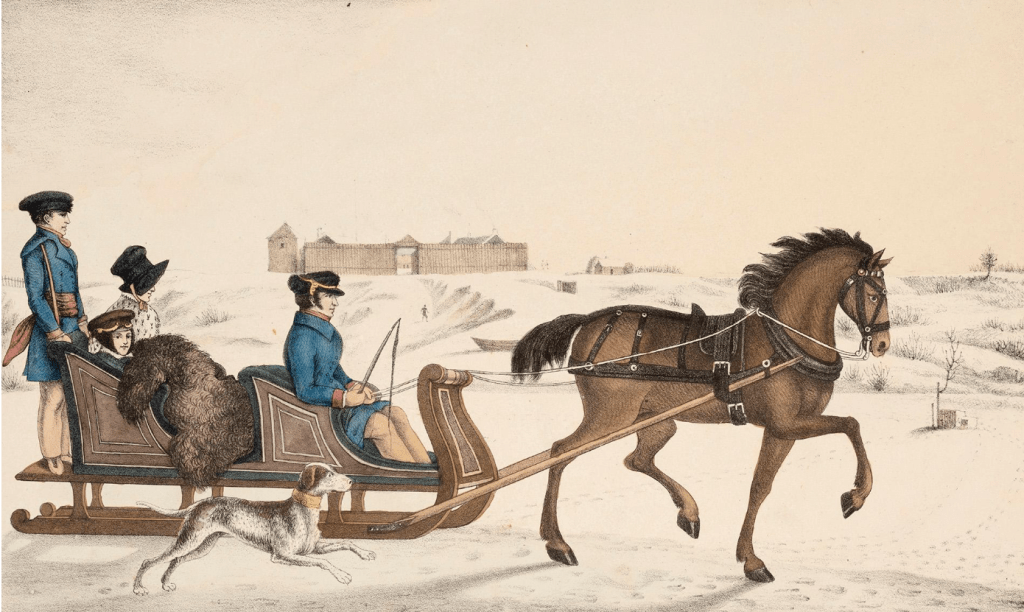
While I would have loved to read this whole book, time constraints meant that I had to choose a specific part. I decided to read the section where the author writes about his journey from Riviere de Cape to York (now known to many as Toronto), Upper Canada. It opens with him riding in a post-cariole, which is another name for a one-horse open sleigh. The imagery that this author summons with his words is wonderful:
“As evening came on, the glowing tints which suffused the bleak landscape were particularly beautiful – such as a winter sunset in Canada can alone produce. The glaring sun became magnified as he touched the horizon. A deep fiery red was reflected from bright tin spires, and blazed from the glass windows of the scattered white houses in the distance. The snow sparkled with purple and varying prismatic colours; while large fragments of ice, scattered here and there, complete a picture of winter in all its intensity.” – pg. 150
The author’s journey is mostly by sleigh, though occasional use of a canoe to traverse the St. Lawrence River is also mentioned. It was interesting reading about his journey into Upper Canada, especially when he refers to Rice Lake, part of the Kawartha Lakes “…so called from the wild rice which grows about it, and which is of a good quality enough, although small and of a brownish colour” (pg. 174). As I have been going to the Kawartha Lakes since I was a child, it felt special to read about known landmarks written almost 200 years ago.
The Wild north land: being the story of a winter journey, with dogs, across northern North America, by William Francis Butler, 1874 – available on Internet Archive
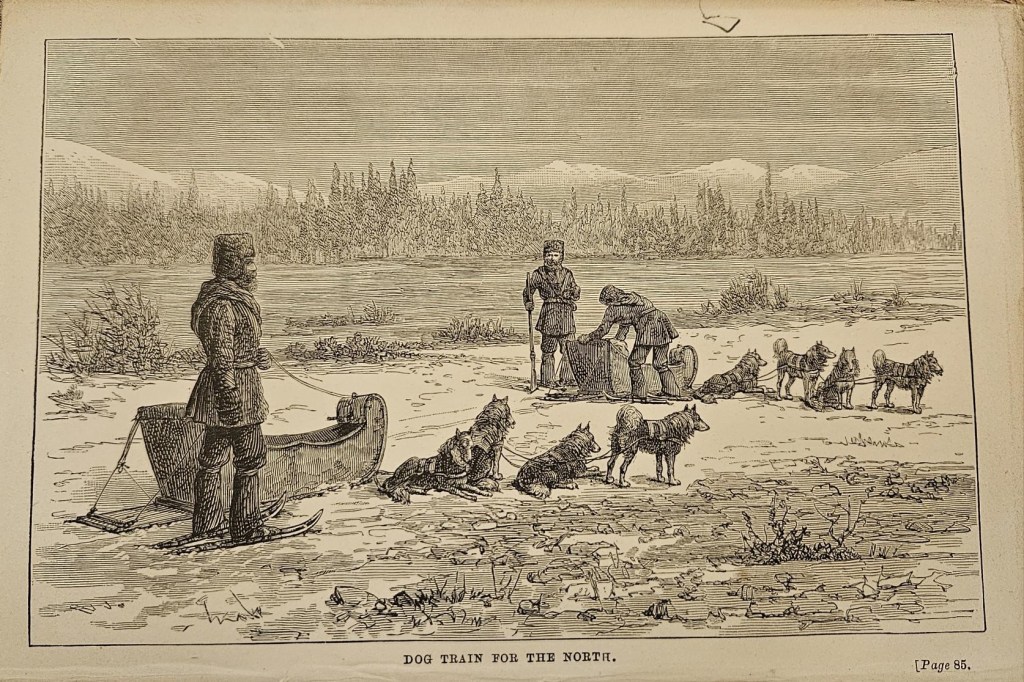
This book covers the author’s journey, which started in the autumn of 1872, from the Red River of the North, to Lake Athabasca by March 1873, and then finally the north part of British Columbia at the end of May 1873. The imagery in this book is a lot more wild than the previous one as he was covering territory without many towns in between. While the journey was mostly made on foot, he occasionally traveled by dog sled. “A dog sled is simply two thin oak or birchwood boards lashed together with deer-skin thongs: turned up in the front like a Norwegian snowshoe, it runs when light over hard snow or ice with great ease; its length is about nine feet, its breadth sixteen inches” (pg. 84). As you can see from the image below, the sleds were pulled by four dogs in tandem style, with the best dog in the lead and the second best at the back.
Across the sub-Arctics of Canada: a journey of 3,200 miles by canoe and snow-shoe through the barren lands by J.W. Tyrrell, 1898 – available on Internet Archive
While this last journey takes place over the summer, it is a trip to survey the lands between Great Slave Lake (in what is now the Northwest Territories) and Hudson Bay, which the author refers to as “terra incognita” or Barren Lands. Many scenes in this book conjure up visions of a winter wonderland, including stumbling upon herds of reindeer. There were so many of them that the author writes, “The valleys and hillsides for miles appeared to be moving masses of reindeer” (pg. 85). He talks at length about the value and usefulness of reindeers and ends with “To those whose imaginations dwell on visions of St. Nicolas and his coursers it is the ideal steed” (pg. 87).

The author’s approach in this book is very methodical and scientific, which makes sense when it is an account of a surveying trip. Nevertheless, he still manages to inject some excitement into the chapters. In between chapters about meeting indigenous and Inuit peoples, he includes a chapter about confronting polar bears, with a pretty dramatic illustration (see below).

We hope that everyone has a cozy and safe holiday season, and we look forward to helping you with your research needs in 2025!
Discover more from Know How, the blog of the Great Library
Subscribe to get the latest posts sent to your email.
 Know How, the blog of the Great Library