LEGISinfo: Tips for Tracking Federal Bill Activity

As some of you may know, the Great Library has been reporting on the legislative activity of Ontario public bills in our new blog series “House of Bills”. Though we don’t cover the federal side of things, here are a few tips for using LEGISinfo to keep track of federal bills as they move through the House of Commons and the Senate.

On the home page of LEGISinfo, you’ll notice that there are a few filter options near the top of the page. For the purposes of tracking the most recent activity of bills, we will be using the “Latest Activity Date” and “Show Details” filters shown below:

By clicking on the “Latest Activity Date”, the bills with the most recent activity are pulled to the top of the page in descending order.

Now that we’ve manipulated the list to show the bills with the most recent activity first, we can use the “Show Details” filter to reveal more information concerning the activity of each bill.  Once expanded, we can now see the last stage the bill has completed under the “Last stage Complete” section and by the bar graph in the top right corner (shown below):

It’s important to note that the data contained in this section reflects the latest stage that the bill has completed, and not necessarily the stage the bill is currently being considered under. For instance, though the entry shown above for Bill C-6 only mentions the first reading, the bill is currently being considered for second reading. If you click the “View Complete Bill Details” link, you will be taken to a page that shows that Bill C-6 sat for second reading on February 24, though it has not yet completed the second reading stage.

For another tool that shows you the latest stage a bill has reached and not necessarily completed, select the “Legislative at a Glance” option located on the left-hand side of the LEGISinfo home page. “Legislation at a Glance” provides an overview of bills under consideration in either the Senate or the House of Commons

House of Bills: A Weekly Update on Ontario Bills

After their winter break, the Legislative Assembly of Ontario is officially back in session as of February 18, 2020.  This also marks the return of the Great Library’s weekly updates of Ontario legislative activity in our House of Bills blog series.

Though the Legislature returned on February 18, our first post of the year includes activity preceding this date. This is because, if designated, committees can meet during any recess or adjournment (Click here for the calendar listing of dates on which committees or the House can meet). We have included all committee activity of this year thus far below.  

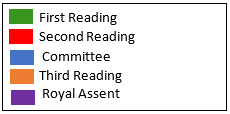
legend

January 2 – February 20
42nd Parliament, 1st Session

Bill 141, Defibrillator Registration and Public Access Act, 2020

Considered by Standing Committee on Social Policy (Jan 16 & 29)

Bill 145, Trust in Real Estate Services Act, 2020

Considered by Standing Committee on General Government (Jan 8, Feb 3 & Feb 19)
Reported as amended (Feb 20)

Bill 156, Security from Trespass and Protecting Food Safety Act, 2020

Second Reading (Feb 18 & Feb 20)

Bill 159, Rebuilding Consumer Confidence Act, 2020

Considered by Standing Committee on Justice Policy (Jan 20-22)

Bill 161, Smarter and Stronger Justice Act, 2020

Second Reading (Feb 19)

Bill 162, Public Accountability and Lobbyist Transparency Act, 2020

Second Reading, Carried (Feb 20)
Ordered referred to Committee of the Whole House (Feb 20)

Bill 163, Food Day Ontario (Food Day Canada in Ontario) Act, 2020

Second Reading, Carried, (Feb 20)
Ordered referred to Standing Committee on General Government (Feb 20)

Bill 167, Legislative Assembly Amendment Act, 2020

Second Reading, Carried (Feb 18)
Ordered referred to Standing Committee on the Legislative Assembly (Feb 18)

Bill 171, Building Transit Faster Act, 2020

First Reading (Feb 18)

Bill 172, Education Statute Law Amendment Act (Fetal Alcohol Spectrum Disorder), 2020

First Reading (Feb 18)

One to Watch – Ontario Bill 161, Smarter and Stronger Justice Act, 2019

The Smarter and Stronger Justice Act, 2019 (Bill 161) was introduced late last year by Attorney General Doug Downey. The stated aim of this ambitious 80-page package of reforms is to simplify Ontario’s complex and outdated justice system. If passed, the bill will make changes, large and small, to over 20 acts impacting the courts, legal aid, legal practice and regulation.

Here are a few key Bill 161 amendments:

Class Proceedings Act (Schedule 4)

  • introduces a more rigorous certification test, new provisions for approval of third-party funding, coordination of multi-jurisdictional actions, administrative dismissal of  dormant proceedings, and procedural changes relating to appeals, carriage motions and settlement and counsel fee approvals

Commissioners for the Taking of Affidavits Act (Schedule 5)

  • allows for virtual (remote) commissioning of documents

Estates Act (Schedule 9)

  • introduces a simplified probate process for small estates

Law Society Act (Schedule 14)

  • grants the Law Society of Ontario the authority to regulate firms, in addition to regulating lawyers and paralegals individually

Notaries Act (Schedule 19)

  • allows paralegals to be appointed as notaries

A complete summary of amendments can be found in the Explanatory Note to Bill 161.

Legal organizations, academics and practitioners have already responded to various aspects of the bill. See for example:

Since Bill 161 received first reading on December 9, 2019, just days before the Legislature adjourned for its winter break, it has thus far not been debated in the House or Committee. But MPPs return to work today, so stay tuned.