Remote Access to Online CPD Materials

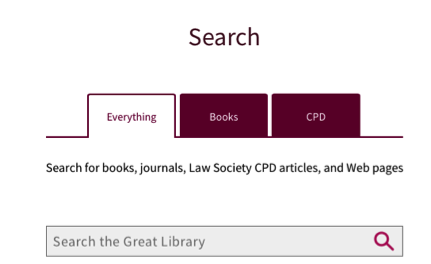
Did you know that you can remotely access continuing professional development (CPD) materials through the Great Library’s catalogue? Whether searching through the “Everything”1or “CPD”2 tab (shown below), you can search, summon, download and send digitized CPD materials remotely.

  1. option 1.png
  2. option 2.png

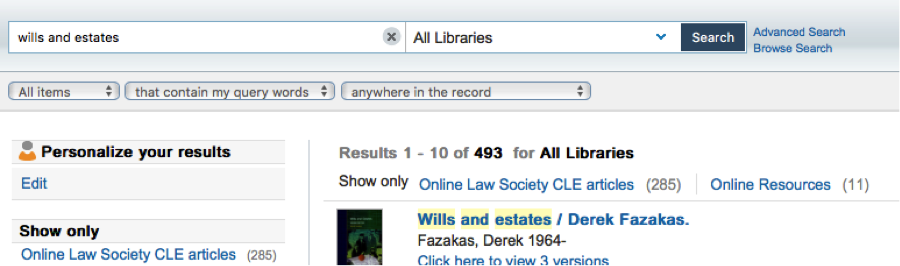
Searches using the “Everything” tab are conducted on the search platform InfoLocate. While searches on this platform will summon results other than CPD materials, you can use the filter “Online Law Society CLE Articles” found on the left to narrow your results to only include online CPD materials. See below:

Infolocate.png
                ☝

Searches using the “CPD” tab are conducted using the database AccessCLE. This database is home to hundreds of free, digitized PDFs of Law Society of Ontario CPD materials.

Another place to look for online CPD materials is CanLII. The County of Carleton Law Association CPD materials from 2018 and 2019 were recently made available on CanLII’s “Commentary” platform. Find these by navigating to the “Conference Proceedings” link on the Commentary page, or click here.

Having access to CPD materials can really come in handy as they are a great way to keep up to date on emerging legal issues and can act as primers or introductory overviews of major legal topics in a given field. They are also great tools for finding forms and precedents!

House of Bills: A Weekly Update on Ontario Bills

After taking a few days to get our ducks in a row, we will be catching up on House of Bills posts for those sitting dates we have missed due to COVID-19 interruptions. Here is the post for the sitting week of March 9-March 12. Stay tuned for the next post which gathers all progress made to Ontario bills in the third and fourth weeks of March during the COVID-19 emergency sitting sessions.

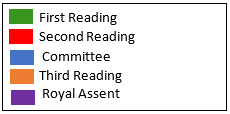
legend

March 9 – March 12
42nd Parliament, 1st Session

Bill 141, Defibrillator Registration and Public Access Act, 2020

Third Reading (March 10 & 11)

Bill 156, Security from Trespass and Protecting Food Safety Act, 2020

Discharge the Order of referral to Committee (from Standing Committee on Justice Policy) (March 9)
Ordered referred to Standing Committee on General Government (March 9)

Bill 159, Rebuilding Consumer Confidence Act, 2020

Second Reading (March 10-12)

Bill 161, Smarter and Stronger Justice Act, 2020

Considered by Standing Committee on Justice Policy (March 12)

Bill 171, Building Transit Faster Act, 2020

Considered by Standing Committee on Social Policy (March 10)

Bill 174, Ditch the Switch Act, 2020

Second Reading, carried (March 12)
Ordered referred to Standing Committee on Regulations and Private Bills (March 12)

Bill 175, Connecting People to Home and Community Care Act, 2020

Second Reading, carried on division (March 9 & 10)
Ordered referred to Standing Committee on Social Policy (March 10)

Bill 177, Sikh Genocide Awareness Week Act, 2020

Second Reading, carried (March 12)
Ordered referred to Standing Committee on Justice Policy (March 12)

Bill 180, Somali Heritage Week Act, 2020>

First Reading (March 10)

Bill 181, Supply Act, 2020

First Reading (March 10)
Second Reading, carried on division (March 11 & 12)
Third Reading, carried on division (March 12)

Bill 182, Franco-Ontarian Emblem Amendment Act, 2020

First Reading (March 10)
Second Reading, carried (March 12)
Ordered referred to Standing Committee on Regulations and Private Bills (March 12)

Bill 183, Strengthening Human Rights in Ontario Act, 2020

First Reading (March 11)

Bill 184, Protecting Tenants and Strengthening Community Housing Act, 2020

First Reading (March 12)

Bill 185, Vision Zero Strategy Act, 2020

First Reading (March 12)

Ephemera in Rare Books

Nowadays, when someone leaves something in a book, it is usually in the form of a bookmark or something that can be used to mark a page. Often librarians find unconventional items left in books or used as bookmarks; items such as tissues, q-tips, and receipts just to name a few. These little scraps left in books can sometimes provide clues about the person who used a book last.

This can get even more interesting when these items are left by someone from the past. While going through our rare book collection, we have found many interesting items left behind in books.

While items left in books do not have a specific term, the closest term to use would probably be ephemera. Maurice Rickards, who wrote the Encyclopedia of Ephemera, defines the term as “the minor transient documents of everyday life”. These documents tend to be either printed or handwritten. Most of the items that we have found in our rare books fit this description, though we have expanded this definition for our purposes to also include other transient items such as dried flowers. Below we have collected some of the more interesting ephemera we have found in our rare books so far:

Letters: Letters can provide insight into why a particular book might have been added to someone’s book collection. A good example of this is a letter written to William Renwick Riddell from Sir Wilfrid Laurier, the 7th Prime Minister of Canada. It is obvious that Wilfrid Laurier and William Riddell exchanged letters before this particular one, which mentions donating the book “Statement concerning Red River Settlement” to which this letter is attached.

Wilfrid Letter

Notes: We have found a variety of notes in many of our rare books, both handwritten and typed, but the note below has to be our favourite. We aren’t quite sure whether this note is a poem or perhaps a grocery list. It’s up to you to decide.

Handwritten note

Newspaper Clippings: Newspaper tends to be flimsy even when first printed, so it is no surprise that it becomes quite brittle as it ages. This makes it hard to preserve, though we do have some good examples from the early 20th century in a book written by Mr. Riddell titled The Legal Profession in Upper Canada, published in 1916. This volume is actually filled with various ephemera, from handwritten notes to typed letters and newspaper clippings.

Newspaper Clippings

Dried Flowers: Occasionally, what you find in books might not be something that was ever meant to be left there. The dried flowers found in an 1815 book is a good example of this. While the book was used to flatten and dry the flowers, presumably it was the owner’s intention to remove them at some point. These flowers were also in the same book where the “poem” was found.

Dried Flowers 2

Advertisements: Ads are usually tailored towards a certain population in a specific time period, so it is definitely interesting when ads from the late 1800s survive to this day. It tells us something about everyday life during that period of time. The ad shown below is from The Ontario Law Directory for 1880 and is an example of an advertisement that you wouldn’t see in 2020.

Advertisment

There are many more examples of ephemera inserted into our rare books, these are just a selection of those that we found the most interesting.

So the next time you come across a piece of paper left in a book, take the time to wonder why the document was left there in the first place.